01
Distributed manufacturing
Advanced manufacturing, digital fabrication, 3D scanning, and qualified technical data, organized so production can live near the operator as well as at a central plant.
 Start a conversation
A distributed manufacturing capability Lone Cowry is developing so operators can turn approved digital manufacturing data into inspectable parts where the work happens, not only where the warehouse sits.
FORGEGRID is how we talk about a named stack: engineering HQ, a controlled digital parts vault, deployable production cells, field systems, and an unmanned-systems fabrication path that is still being developed. Critical low-volume parts should be manufacturable from qualified data at the point of need.
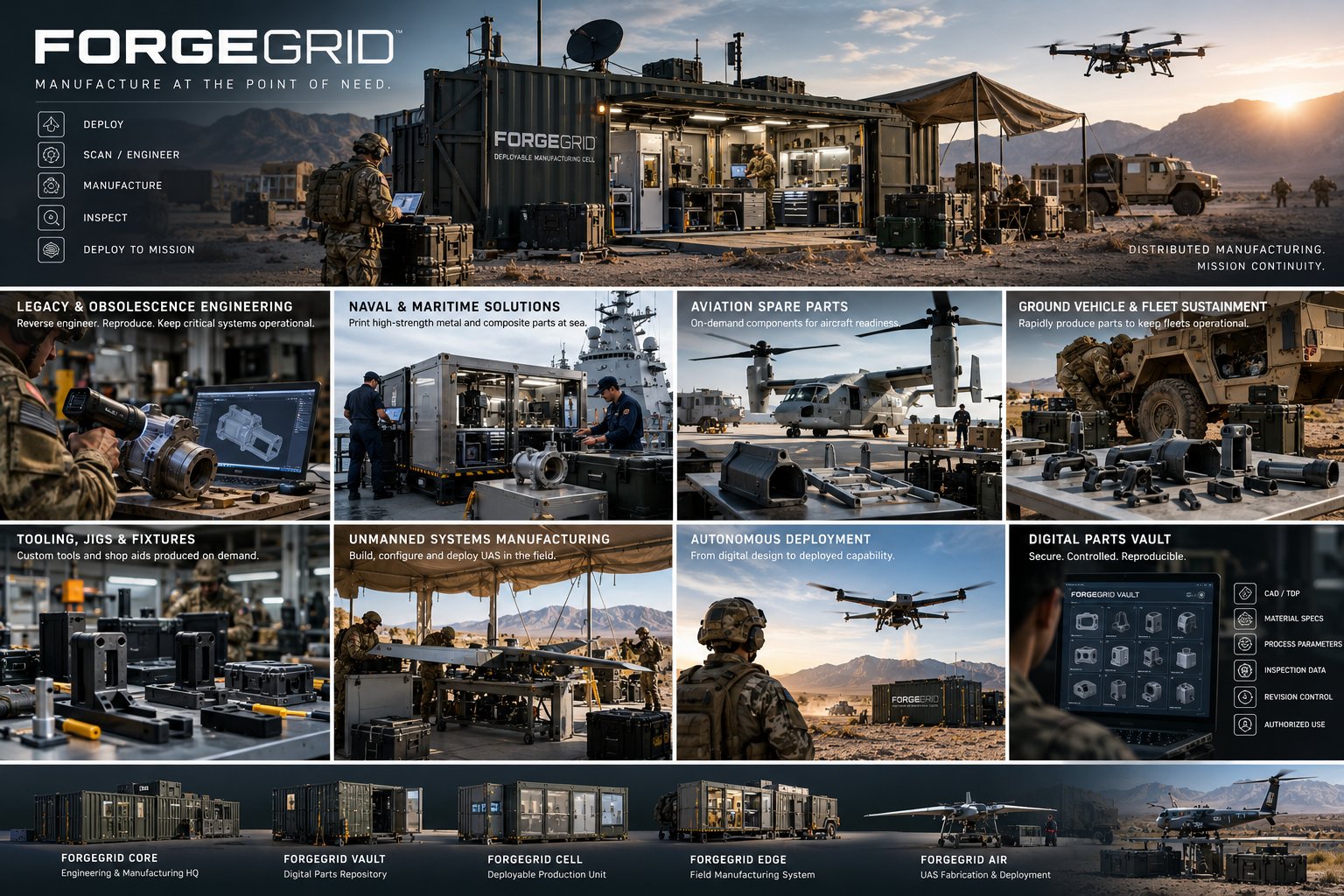
A repeatable loop from the missing part to an inspected asset back in service.
Name the part, the platform it belongs to, and the authority that governs repair or replacement.
Pull an approved technical data package from the vault, or capture geometry and context with controlled scanning when data does not yet exist.
Confirm materials, process parameters, revision, and authorized use before any build starts.
Produce on additive, subtractive, or hybrid equipment inside a Core, Cell, or Edge configuration matched to the site.
Check the part against the inspection data that travels with the manufacturing package.
Return the asset to service, or release a field-built system once configuration and validation are complete.
Aligned with how defense and maritime operators are moving manufacturing closer to the point of need, and useful anywhere a low-volume part becomes a readiness problem.
Advanced manufacturing, digital fabrication, 3D scanning, and qualified technical data, organized so production can live near the operator as well as at a central plant.
Reverse engineer worn or discontinued components, rebuild the manufacturing data, and keep critical systems operational when the original supply chain has gone quiet.
Deployable production units sized for bases, ships, and remote sites. The cell is the manufacturing floor that travels with the mission.
Custom shop aids produced on demand so maintainers are not waiting on a catalog item that was never stocked for their bay.
A path we are developing to build, configure, validate, and deploy unmanned systems from a cell. Treat this as aspirational until fielded configurations are ready.
A controlled repository of manufacturing data: CAD and technical data packages, material specs, process parameters, inspection data, revision control, and authorized use. Digital inventory sits beside physical stock for the parts that matter most.
Five named configurations. Status across the line is in development.
Engineering and manufacturing HQ. Where packages are authored, qualified, and released into the vault.
Controlled digital parts and technical data package repository. Secure, revisioned, and scoped to authorized use.
Deployable production unit. Containerized or site-installed manufacturing capacity for bases and forward locations.
Field manufacturing system. Smaller footprint for trucks, ships, and constrained sites that still need to produce.
UAS fabrication and deployment capability. Being developed as an extension of the Cell path into unmanned systems.
Design centrally. Manufacture locally. Keep inspection in the loop.
Author and store approved manufacturing data
Controlled delivery to authorized sites
Produce at the point of need
Match the package inspection data
Return to service or deploy
Autonomous extension under development: Cell → manufacture UAS → configure → validate → deploy.
Operators who cannot wait out a long supply queue for a low-volume part, and organizations that want digital inventories of approved manufacturing data next to physical stock.
FORGEGRID is built around rights the customer already has or negotiates: manufacturing rights scoped in contract, technical data packages, and repair provisions. It is not a blanket IP giveaway, and it is not a promise of unrestricted right-to-repair for every customer or every part.
The requirement is clear authority. If the package is approved for a given use, the site that holds that authority should be able to manufacture, inspect, and return the asset without inventing a new supply chain from scratch.
If you are scoping point-of-need manufacturing, a digital parts vault, or a deployable cell, we can walk through what FORGEGRID is being built to cover and what is still in development.
Start a conversation